WESTNILE - As the global community rallies under the banner of World Environment Day 2026, focusing on land restoration, desertification, and drought resilience, a quiet but devastating crisis is unfolding in northwestern Uganda. The West Nile sub-region is currently ground zero for an acute form of climate injustice where those least responsible for global emissions are paying the ultimate price with their livelihoods, their environment, and their fundamental human rights.
A landmark research report by Rural Initiative for Community Empowerment West Nile (RICE West Nile), the Africa Centre for Energy and Mineral Policy (ACEMP), Friends of Zoka, and Sustainable Plan and Action for Community Empowerment (SPACE) in partnership with Muni University under the Strengthening Environmental Accountability and Climate Action in West Nile and Karamoja (SEA WNK) has laid bare the staggering ecological and human cost of climate shift in the region. Funded by prominent development partners including Denmark, the Netherlands, Sweden, and Ireland, the findings offer an unattractive reference point of environmental degradation and socio-economic vulnerability.
A Region Under Climatic Siege
The empirical evidence indicates that the West Nile region has become progressively warmer and drier. An overwhelming 93.3% of local communities report heavily increased temperatures, while 82.5% are grappling with highly irregular rainfall patterns. In a region where nearly nine out of ten households (89.4%) rely entirely on subsistence, rain-fed farming for survival, these atmospheric shifts are catastrophic. The Ministry of Water and Environment (MWE) Uganda Strategic Program for Climate Resilience (SPCR) explicitly breaks down regional vulnerability profiles, naming West Nile and the neighboring cattle corridor as areas facing unprecedented drought risks and rapid ecosystem degradation.

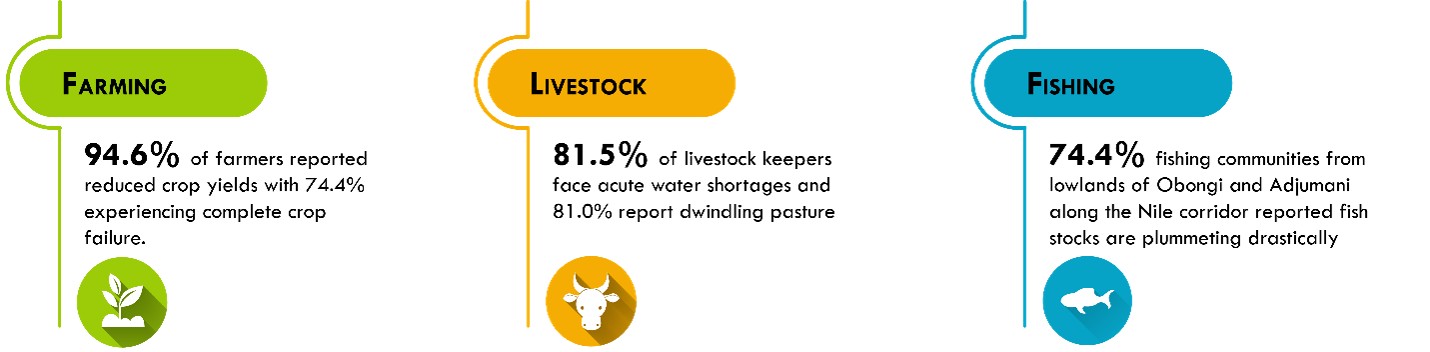
The impacts have rippled violently across local economies: 94.6% of farmers reported reduced crop yields, with 74.4% experiencing complete crop failure. Maize and beans have emerged as the most climate-susceptible crops. 81.5% of livestock keepers face acute water shortages, and 81.0% report dwindling pasture, triggering animal productivity losses and resource-driven conflicts. In the lowlands of Obongi and Adjumani along the Nile corridor, fish stocks are plummeting drastically, reported by 74.4% of fishing communities.
A Geographic Information System (GIS) spatial analysis featured in the report confirms that permanent wetlands in the region contracted by an alarming 28.7% between 2001 and 2021. Concurrently, vast tracts of stabilizing savanna ecosystems were aggressively converted into fragmented cropland to offset falling yields, driving a dangerous feedback loop of deforestation and soil erosion.
The Human Rights Dimensions of Climate Injustice
Development partners and researchers emphasize that environmental degradation in West Nile is no longer just an ecological talking point; it is a severe human rights crisis. Climate shocks are actively undermining the rights to water, food, and health services.
Crucially, this vulnerability is fundamentally uneven. The report highlights that marginalized groups are bearing a disproportionate weight of the crisis. Women are experiencing pronounced deprivation in food security, livelihoods, and participation in decision-making. Youth face structural barriers in climate-affected sectors of work and education. Meanwhile, the massive influx of refugees from South Sudan and the Democratic Republic of Congo has heightened localized pressure on dwindling biomass and land resources, leaving refugee households suffering severe deprivation in food security and livelihood stability.
Despite this compounding structural stress, external institutional backing remains shockingly sparse. Only 17% of respondents across the sub-region reported ever receiving any form of external assistance or programmatic relief to build climate resilience.
A Call to Action
The time for bureaucratic complacency has passed. If the theme of World Environment Day 2026 is to be actualized as a lived reality rather than an empty slogan, duty-bearers must step up immediately.
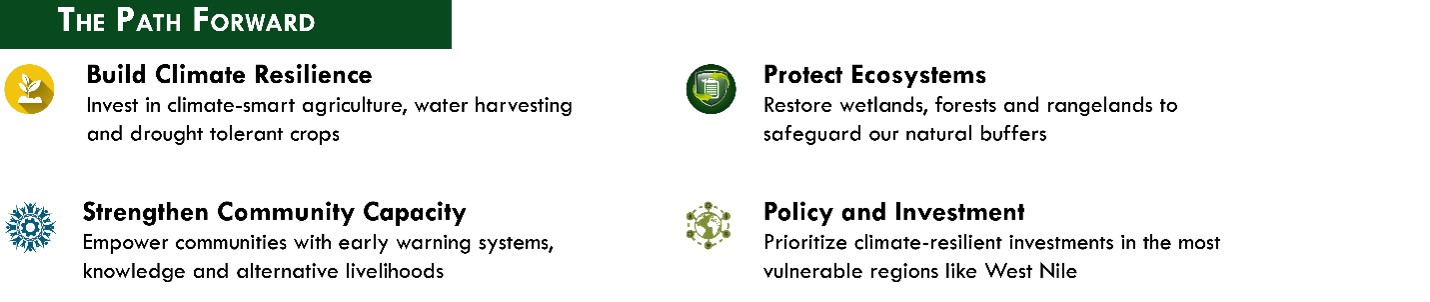
First, District Local Governments, Ministries, Departments, Agencies, and international development partners need to urgently scale up financing for inclusive, climate-smart agriculture. This demands the widespread distribution of drought-tolerant crop varieties such as resilient cassava, sorghum, and millet and localized, small-scale irrigation infrastructure to decouple production from erratic rainfall.
Second, environmental accountability must be strictly enforced. High-impact local drivers of degradation, such as commercial charcoal production, wetland drainage, and unregulated sand mining near surface water bodies, must be curbed through stringent law enforcement and community-led restoration frameworks.
Finally, climate justice dictates that adaptation must be intersectional. Social protection programs and agricultural extension outreach need to explicitly target female-headed households, youth, persons with disabilities (PWDs), and refugee communities. We need to equip the most vulnerable with alternative, non-farm income streams.
West Nile cannot wait another decade for trickle-down climate finance. The foundations of its ecological and human survival are fracturing today. We must act now to restore the land, protect fundamental human rights, and deliver true distributive and procedural climate justice to the people of West Nile.
Access to the Full Research Report
Authored by Rolex Aleku – RICE West Nile
The "Strengthening Environmental Accountability and Climate Action in West Nile and Karamoja" project is funded by the Danish Ministry of Foreign Affairs (MFA) through Danida. The project is implemented in the districts of Zombo, Madi Okollo, Obongi, Adjumani, Amudat and Nakapiripirit by a consortium of four national organizations: RICE West Nile (lead implementer), Friends of Zoka, Sustainable Plan and Action for Community Empowerment (SPACE) and Africa Center for Energy and Mineral Policy (ACEMP).