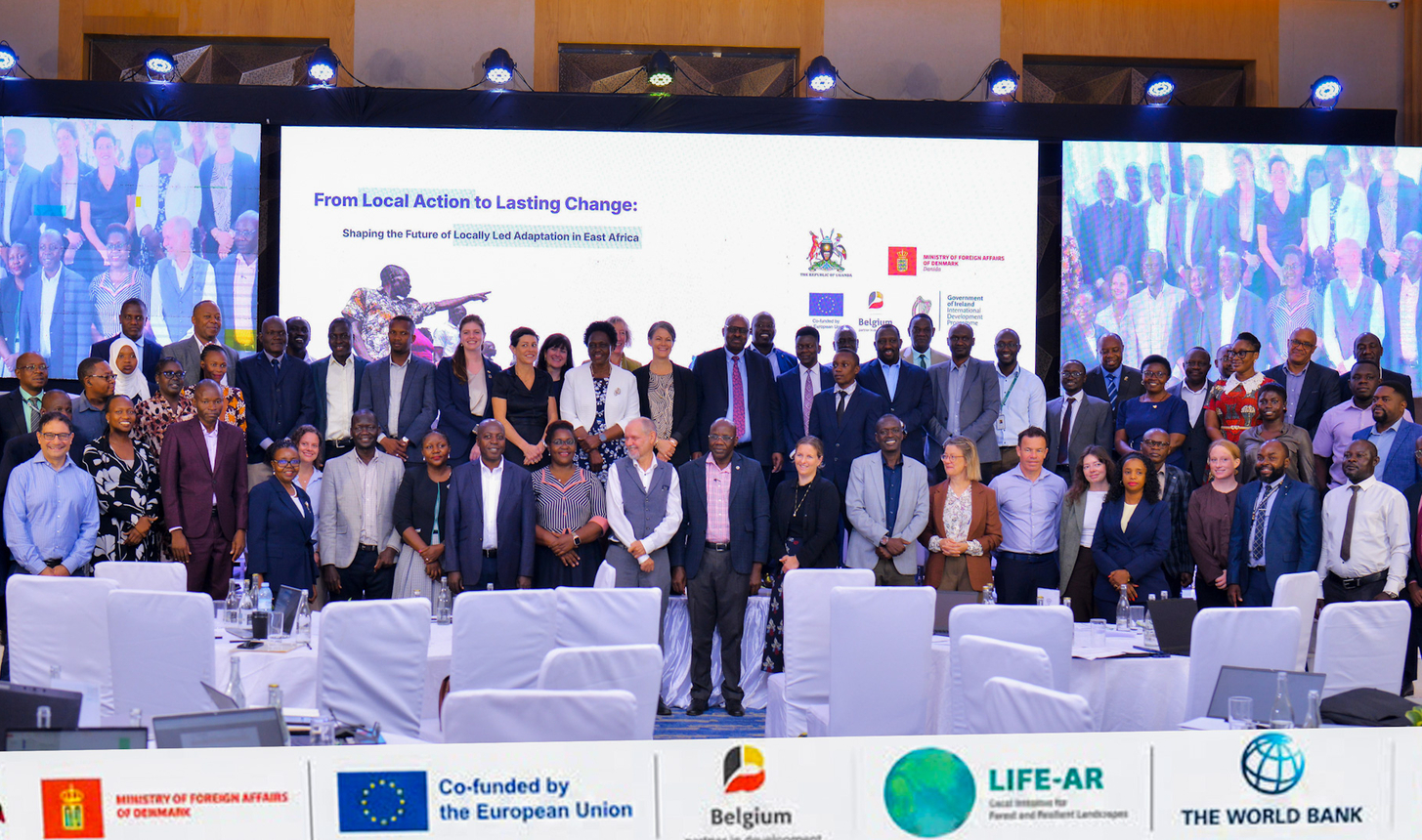
On 7th October 2026, climate change advocates from the East African Region converged in Kampala to lay down strategies of strengthening financing for locally-led climate adaptation across the region.
Hosted by the Government of Uganda with support from the Danish Embassy in Uganda and the United Nations Capital Development Fund (UNCDF), the regional Locally Led Adaptation (LLA) workshop provided a platform for experience sharing for LLA practitioners in Uganda, Kenya and Tanzania. The event brought together local governments, central governments, the private sector, civil society, academia, and development partners from the three East African countries to dialogue and shape the future of locally led adaptation in the region.
In his opening remarks, Local Government Permanent Secretary, Ben Kumumanya, laid the foundation for the two-days engagement, describing climate change as the “defining challenge of our time” while noting that the phenomenon does not respect national borders. “Resilience of one country is inseparable from resilience of its neighbours,” he told delegates.
Locally Led Adaptation is a bottom-up approach that puts local communities, district governments and grassroot institutions in charge of identifying, planning, and financing climate resilience actions. It encourages devolved decision-making, where power and resources are shifted down to district and village levels so that communities can draft their own Village Climate Adaptation Plans.
The Uganda Government, with support from the UNCDF and partners, operates the Local Climate Adaptive Living (LoCAL) Facility, which channels performance-based climate resilience grants directly to local governments. This approach is also implemented in Kenya through FLLoCA - Financing Locally Led Climate Action; and in Tanzania through the Scaling-up Locally Led Climate Action Program (SCALE), a $110 million World Bank-backed initiative designed to strengthen government systems and fund grassroos climate resilience.
Lynn Waller, Embassy of Ireland’s Development Specialist Officer, commended the Uganda government for leadership in mobilising climate finance, saying Ireland remains committed to supporting the country’s climate agenda. “People living on the frontline must be at the centre of climate adaptation,” she said. “Adaptation works best when solutions are shaped by the people who know them best.”
The Danish Ambassador to Uganda, HE. Signe Winding Albjerg, informed delegates that locally led adaptation was increasingly featuring in different programs and projects supported by Denmark in East Africa.
“Through these programs, Denmark is very proud to stand with the governments, local government and local communities, in Kenya, Tanzania and Uganda to strengthen the very institutions and communities that are redefining what climate adaptation looks like and should look like in the future,” she said. “We see these partnerships as true partnership in action, delivering practical, life-changing solutions exactly where they matter the most,” she added, noting that “climate adaptation and resilience is won or lost at the local level.”
HE. Signe Winding Albjerg urged the delegates to pick genuine lessons from the workshop, both the good practices across the three countries, as well as the hard lessons so that the same mistakes are not repeated. “For East Africa, more than any other region, you share water bodies, land borders, different climate variations and you also share a lot of collaboration, infrastructure, trade, internal investments. So you have every opportunity to assist each other, including the resilience that will not only help your own country, your own community, but also that of your neighbour.”
She said the workshop offered an opportunity for locally led adaptation achievements, experiences and lessons learned from Kenya, Tanzania and Uganda to influence global policy in various fora, such as the upcoming COP 31.
In February, the Embassy of Denmark in Kampala committed $23.47 million to UNCDF to enable local governments and communities in Uganda to strengthen local economies through UNCDF’s LoCAL+. For the first time, this will include a new component to enable future engagement with the private sector and unlock new investment for locally led, green economic development and build the necessary architecture to eventually deploy instruments such as blended finance and guarantees for green small and medium-sized businesses.
Indeed, the Kampala workshop acknowledged the role of private sector financing in unlocking large-scale capital for locally-led climate adaptation by transforming community resilience needs into structured, investable opportunities.
David Busienei, a Climate Justice Advocate from Kenya noted that private sector has the capacity and infrastructure to carry an innovation from the community and scale it up to a much wider scale thus shifting the perception of climate adaptation from a grant-dependent charity to a profitable, self-sustaining market. “Grants will fund the period of the program, but private sector will fund the scale up and technology to scale,” he argued.
As a result, he said, private sector enhances sustainability of locally led adaptation programs. “Private sector will bring in knowledge management, quality control, discipline to keep adaptation assets alive.”
In her remarks, the Guest of Honour, Hon. Beatrice Anywar, Uganda’s Minister of State for Environment, appreciated locally led adaptation strategies for involving the communities that bear the brunt of climate change the most. “For too long, indeed, climate strategies have been designed and discussed far away from where the effects are felt. And now this must shift,” she said.
The LoCAL facility operates through performance-based climate resilience grants, disbursed through the national Intergovernmental Fiscal Transfer (IGFT) system to provide predictable funding for districts to implement adaptation projects that range from water management and sustainable agriculture, to infrastructure improvements that reduce vulnerability to floods, drought and other natural disasters.
The "Strengthening Environmental Accountability and Climate Action in West Nile and Karamoja" project is funded by the Danish Ministry of Foreign Affairs (MFA) through Danida. The project is implemented in the districts of Zombo, Madi Okollo, Obongi, Adjumani, Amudat and Nakapiripirit by a consortium of four national organizations: RICE West Nile (lead implementer), Friends of Zoka, Sustainable Plan and Action for Community Empowerment (SPACE) and Africa Center for Energy and Mineral Policy (ACEMP).