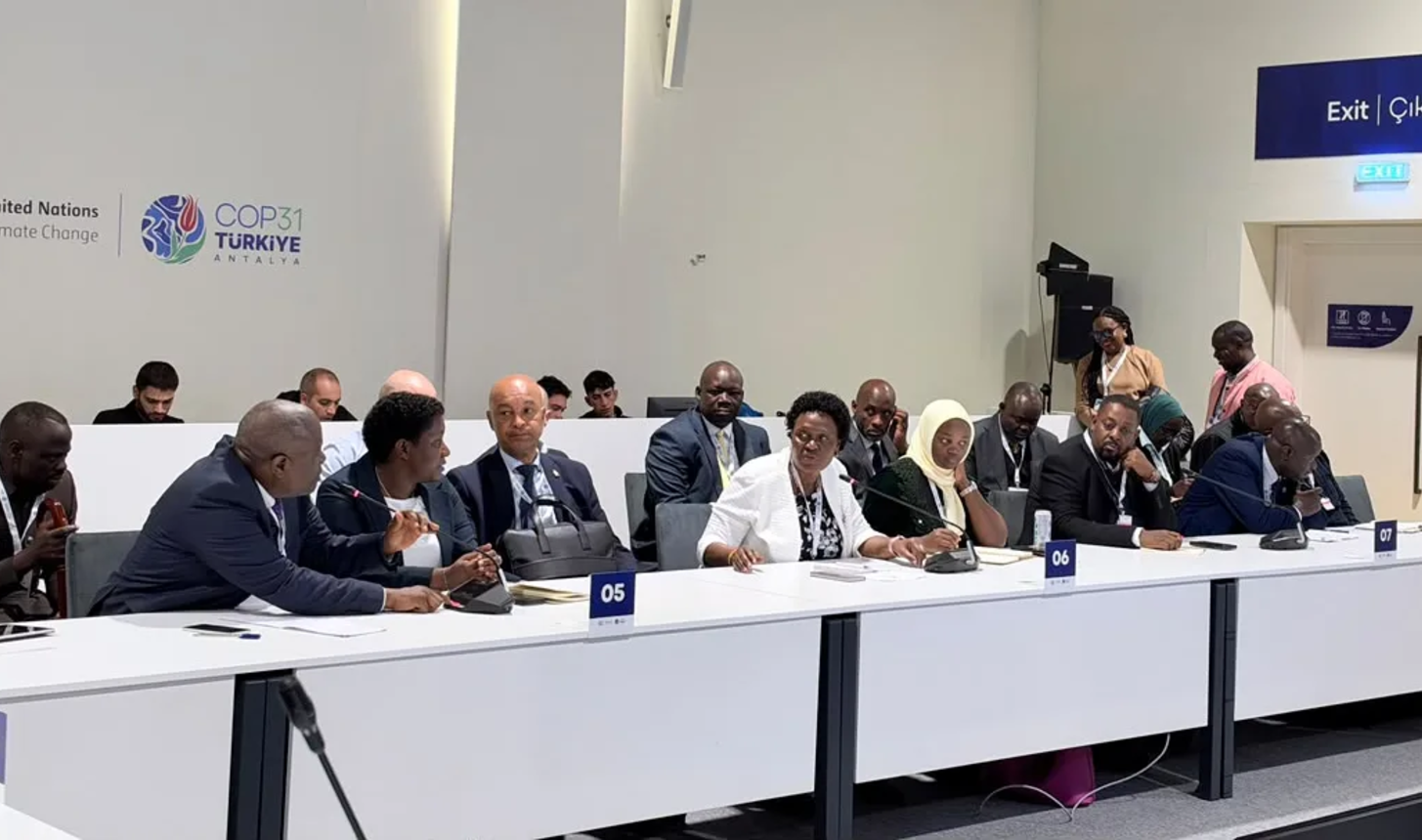
As the 31st United Nations Climate Change Conference (COP31) concluded in Antalya, Türkiye, Uganda emerged from the talks having walked a tightrope familiar to many resource-rich developing economies. Operating within the African Group of Negotiators, the Least Developed Countries (LDC) Group, and G77 + China, Kampala’s delegation pressed wealthy nations for urgent adaptation finance while fiercely defending its sovereign right to develop its natural resources—specifically a fast-maturing critical minerals sector—to anchor its economic transformation.
Led by the Minister of State for Environment, Hon. Beatrice Atim Anywar, Uganda’s multi-sectoral delegation brought together senior diplomats, Members of Parliament, and technocrats from the Ministries of Local Government and Finance.
For Uganda, the negotiations were framed by immediate domestic realities. Deadly landslides, severe flooding, and prolonged droughts continue to erode agricultural yields, damage infrastructure, and threaten hydropower stability. Facing an estimated $28.1 billion price tag to implement its national climate commitments—roughly 85% of which requires external mobilization—Minister Anywar used UNFCCC plenaries to criticize unfulfilled Global North finance pledges and reject "one-size-fits-all" transition mandates.
At the Uganda Pavilion, officials paired these demands with concrete governance tools, launching a National Carbon Project Register alongside the Forest-to-Forest initiative, which twins Uganda’s 506 Central Forest Reserves with international conservation partners.
Critical Minerals: Moving Beyond Raw Extraction
Beyond adaptation finance, critical energy transition minerals stood out as one of the most consequential battlegrounds for Uganda in Antalya. As global demand surges for lithium-ion batteries, wind turbines, and solar grids, Uganda has moved aggressively to position itself as a strategic supplier—not of raw ores, but of processed, value-added mineral products.
Speaking at the launch of the Least Developed Countries Green Industrialization Facilitation Mechanism (LDC-GIF), Ambassador Adonia Ayebare emphasized that Uganda is actively seeking global industrial partnerships to keep mineral value addition within its borders, leveraging its abundant hydropower and solar base to power low-carbon refining.
Inside the negotiating rooms, Uganda backed efforts under the Just Transition Work Programme (JTWP) that achieved a historic milestone: for the first time, a COP decision explicitly linked transition minerals to human rights, technology transfer, and domestic value addition in producer countries—even though broader political deadlocks over fossil fuels and finance pushed the operationalization of the Just Transition Mechanism to COP32 in Addis Ababa in 2027.
Uganda’s posture at COP31 rests on major legal reforms designed to overhaul its extractive sector. Under the Mining and Minerals Act, 2022, all mineral rights are vested in the government on behalf of citizens. Crucially, the legislation mandates domestic beneficiation, outlaws toxic mercury use in gold processing, formalizes artisanal and small-scale miners through dedicated license tiers, and establishes the state-owned Uganda National Mining Company (UNMC) to manage the state’s mandatory 15% free-carried equity stake and commercial participating interests.
These legal provisions are already shaping activity across Uganda’s flagship transition mineral sites.
The shallow, high-grade Orom-Cross Graphite Project in Kitgum District, operated by UK-based Blencowe Resources, is slated to begin initial concentrate production in 2027. In line with national beneficiation rules, the project plans to construct a local Spheronised Purified Graphite (SPG) facility by 2028, potentially making Uganda the first African nation to export battery-grade purified graphite.
The Makuutu Rare Earth Project, which straddles Bugiri, Iganga, and Mayuge Districts, is being developed by Rwenzori Rare Metals with UNMC as a state commercial partner; while efforts to redevelop Uganda’s historic copper and cobalt hub in Kilembe, Kasese District, remain central to the country’s broader strategy to supply regional battery and grid-infrastructure value chains.
With COP32 set for Addis Ababa in 2027, Uganda has signalled that East Africa will keep climate finance, bilateral green partnerships, and fair, value-added mineral governance squarely at the center of global climate diplomacy.
Chris Musiime